
Powerlifting Coaching: Which Option Is Actually Right for You?
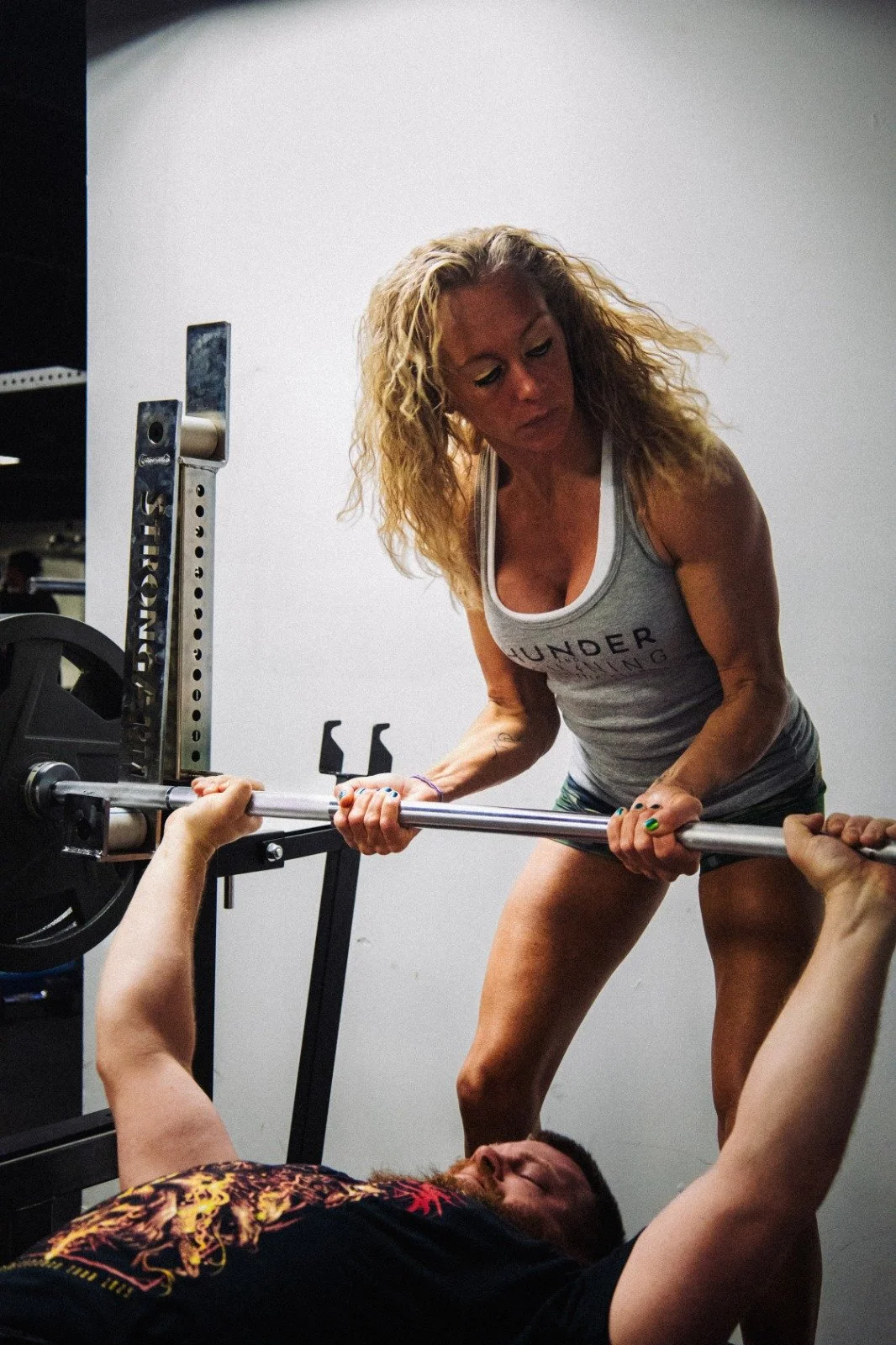
1-1 Personal Training for Powerlifting is the gold standard.
Powerlifting is one of the most exciting sports you can take up. The squat, bench press, and deadlift look simple from the outside. Three movements. Maximum weight. Straightforward. Low barrier for entry.
But anyone who has spent serious time under a bar knows the truth. Each lift is a skill. And like any skill, how fast you develop it, how safely you develop it, and how far you ultimately take it depends enormously on the quality of instruction you receive along the way.
There are more coaching options than ever before. Group classes, personal training, small group training, online coaches, youtube, and AI generated programs all promise to get you stronger. They are not equal. Here is an honest breakdown of what each actually gives you, and where each one falls short.
Group Classes
Group fitness have genuinely changed a lot of people's lives. It creates a community, gives structure and leads to the consistency necessary to improve. In a powerlifting specific group class with an experienced coach and a sensible cap on class size, you can make serious, sustained progress.
Here is why: consistency and progressive overload are the two most powerful variables in strength development. A well run group powerlifting class delivers both. You show up on a schedule, you follow a program, and the intensity increases over time. Twenty years of coaching bears this out. That formula gets results, reliably, for the vast majority of people.
The honest limitation of group programming is not the coaching in the room. It is that the program itself is written for the group rather than the individual. Your proportions, your injury history, your weak points, and your leverages all affect how these movements should look for your body and how your training should be structured over time. A group program does its best to serve everyone well. But it cannot be optimized past a certain point for any one person the way an individualized program can.
For most lifters, especially those building their foundation, that limitation is minor compared to the value of consistent, coached training in a room full of people working toward the same goals. A great group class will take you further than a mediocre individual program.
Best for: Lifters at any level who want structured, coached powerlifting training in a motivated group environment. Limitation for powerlifting: Programming is designed for the group, not the individual. Specific adjustments to volume, intensity, and variation based on your personal history and goals require a more individualized approach.
AI Generated Programming
This one is worth addressing directly because it is becoming more common and the marketing around it is persuasive.
AI can write a program. It can apply progressive overload, manage volume and intensity, and produce something that looks legitimate on paper. For general strength training, a well structured AI program is better than no program at all.
But powerlifting is where AI runs into a hard wall.
A program is only part of coaching. The other part is watching you move and knowing how to fix what it sees. Knowing when a person can be pushed. Knowing when there is an injury creeping up or how to train around one. These require a human eye, accumulated experience, and the ability to reach into a library of different cues and know the lifters history.
Experienced coaches know that the same technical problem responds differently to different cues depending on the athlete. One lifter fixes their squat depth when told to push their knees out. Another needs to think about spreading the floor. A third responds to a completely different cue entirely. Finding the right one is not algorithmic. It is pattern recognition built from years of watching hundreds of different bodies move under load.
AI cannot watch you lift, (yet). It cannot adjust next week's training based on how you moved today. It cannot tell you that your lower back is rounding because your lats are not engaged, or that your bench is stalling because of a technique issue rather than a strength issue. And critically, it cannot be held accountable when something goes wrong.
For powerlifting, AI programming without human oversight is a shortcut that tends to catch up with you eventually, usually in the form of a plateau or an injury that a coach would have seen coming.
Best for: General training structure if no coach is available. Limitation for powerlifting: No ability to observe movement, correct technique, or provide the individualized cues that technical lifting requires.
Online Coaching
Online coaching gets a mixed reputation, and the truth is that the quality varies enormously depending on the coach.
A genuinely good online powerlifting coach can take you a long way. They will write programming tailored to your history and goals, review video of your lifts regularly, and provide detailed technical feedback between sessions. For intermediate and advanced lifters who already have solid technique foundations, a good online coach is a legitimate and cost effective option.
The limitations are real though. Feedback is delayed. You film a set, send it, and wait. In the meantime you might repeat the same error across multiple sessions before it gets corrected. For lifters still building their technique foundations, that lag matters.
There is also no physical presence. A coach in the room with you picks up on things that do not show up on a phone camera. They can see your bracing from an angle the camera misses. They notice you hesitate before a heavy attempt. They can make a small adjustment to your setup that changes everything, which is difficult to communicate through a video review.
The other variable is accountability. With an in person coach, you show up because someone is expecting you. With an online coach, that relationship depends heavily on the individual and how seriously they manage their athletes. Some online coaches run lean operations with dozens of clients and limited individual attention. Others are meticulous. You need to know which one you are getting.
Best for: Intermediate to advanced lifters with solid technique who want structured programming and periodic feedback. Limitation for powerlifting: Delayed feedback, no physical presence, and accountability that varies by coach.
1 on 1 Personal Training
This is the gold standard for powerlifting coaching, and it is not particularly close.
A dedicated 1 on 1 powerlifting coach gives you their complete attention for every session. Every set is watched. Every rep is assessed. Technique corrections happen in real time, not after a video review. Programming is adjusted based on how you actually moved that day, not how you were supposed to move.
The cue library matters enormously here. An experienced coach who has worked with many different lifters has seen the same technical problems solved in dozens of different ways. They know that when one cue does not land, there are five others to try. They read you over time and develop an understanding of how your body responds, what motivates you, and where your patterns break down under fatigue or heavy load. That accumulated knowledge is genuinely hard to replicate in any other format.
For anyone serious about competing in powerlifting or lifting as heavy and as safely as possible, 1 on 1 coaching is the most direct path.
The barrier is cost. Quality 1 on 1 powerlifting coaching typically runs between $100 and $150 per session. Training twice a week puts you at $800 to $1,200 per month. For most people that is not a realistic long term budget, and it means the gold standard sits out of reach.
Best for: Anyone serious about powerlifting technique, competition prep, or maximizing their long term progress. Limitation: Cost puts it out of reach for most people training twice a week or more.
Small Group Personal Training
Small Group Personal Training sits in the gap between 1 on 1 coaching and everything else, and for powerlifting it is a genuinely strong option.
SGPT sessions are capped at four people. That number is not arbitrary. At four, a coach can watch every set of every person in the room. Nothing gets missed. You are not waiting for the coach to rotate around to you. They are there, they are watching, and they are correcting in real time.
Every person in the group follows their own custom program. You are not doing someone else's squat variation because it fits the class template. You are doing your squat, at your load, with your cues, progressed at your rate.
For powerlifting specifically, this matters. The technical demands of the squat, bench, and deadlift do not change because you are training near other people. You still need individualized feedback. You still need a coach who has seen your movement patterns long enough to know what you need. You still need programming that accounts for your history, your proportions, and your goals. SGPT provides all of that.
What it adds that 1 on 1 training does not is the energy of training alongside other serious people. That is not a small thing. Powerlifting is a sport where the mental side of heavy lifting matters. Training in a room where other people are also pushing their limits changes the atmosphere of a heavy set in ways that training alone simply does not.
And the cost works out to a fraction of private training. Two sessions a week comes to $52.50 per session. Three times a week drops to $50. No contracts.
how fast you develop POWERLIFTING SKills, how safely you develop them, and how far you ultimately take the sport depends enormously on the quality of instruction you receive along the way.
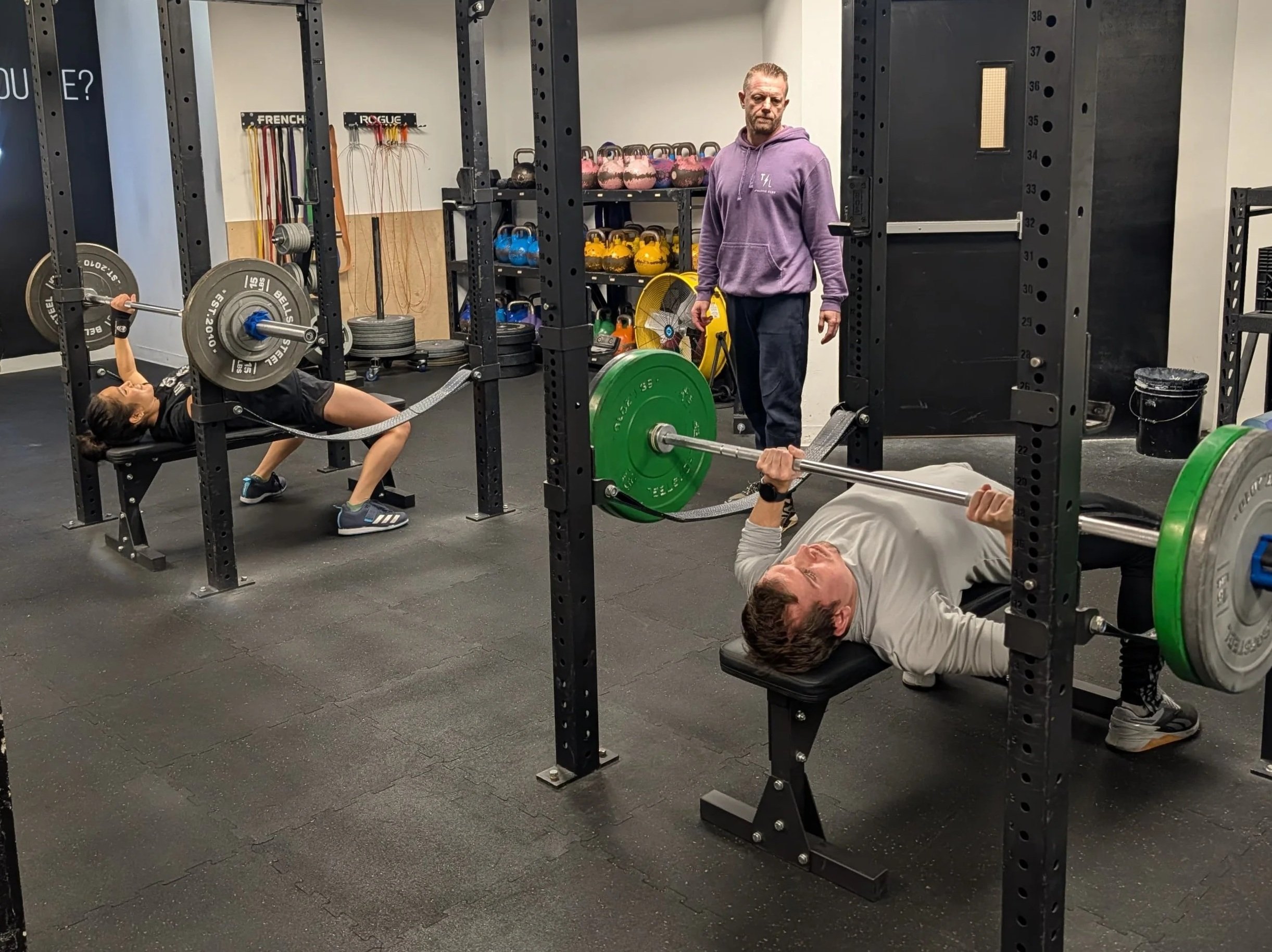
Small Group Personal Training is amazing for serious gains.
So Which One Is Right for You?
If you are just starting out and want to get into powerlifting in a structured, coached environment, a well run group class is a legitimate and effective place to begin. You will build consistency, learn the movements, and make real progress. The ceiling only becomes relevant once your goals require programming built specifically around you.
If you are an intermediate or advanced lifter with solid foundations and a limited budget, a genuinely good online coach is worth considering. Do your research and make sure they are actually watching your lifts.
If you are serious about powerlifting and want the fastest, safest route to real technical development, the choice comes down to 1 on 1 personal training and small group personal training. The difference between them is cost and atmosphere. The coaching quality, when the group is kept small enough, is comparable.
For most people, Small Group Personal Training is where that equation lands. You get eyes on every rep, a program built for you, and people beside you who make the hard days easier to show up for.
If you want to talk through what that looks like for your specific goals, that is exactly what our free No-Sweat Intro is for.