
Getting Back to Training After Baby: What's Safe, What Helps, and How to Start
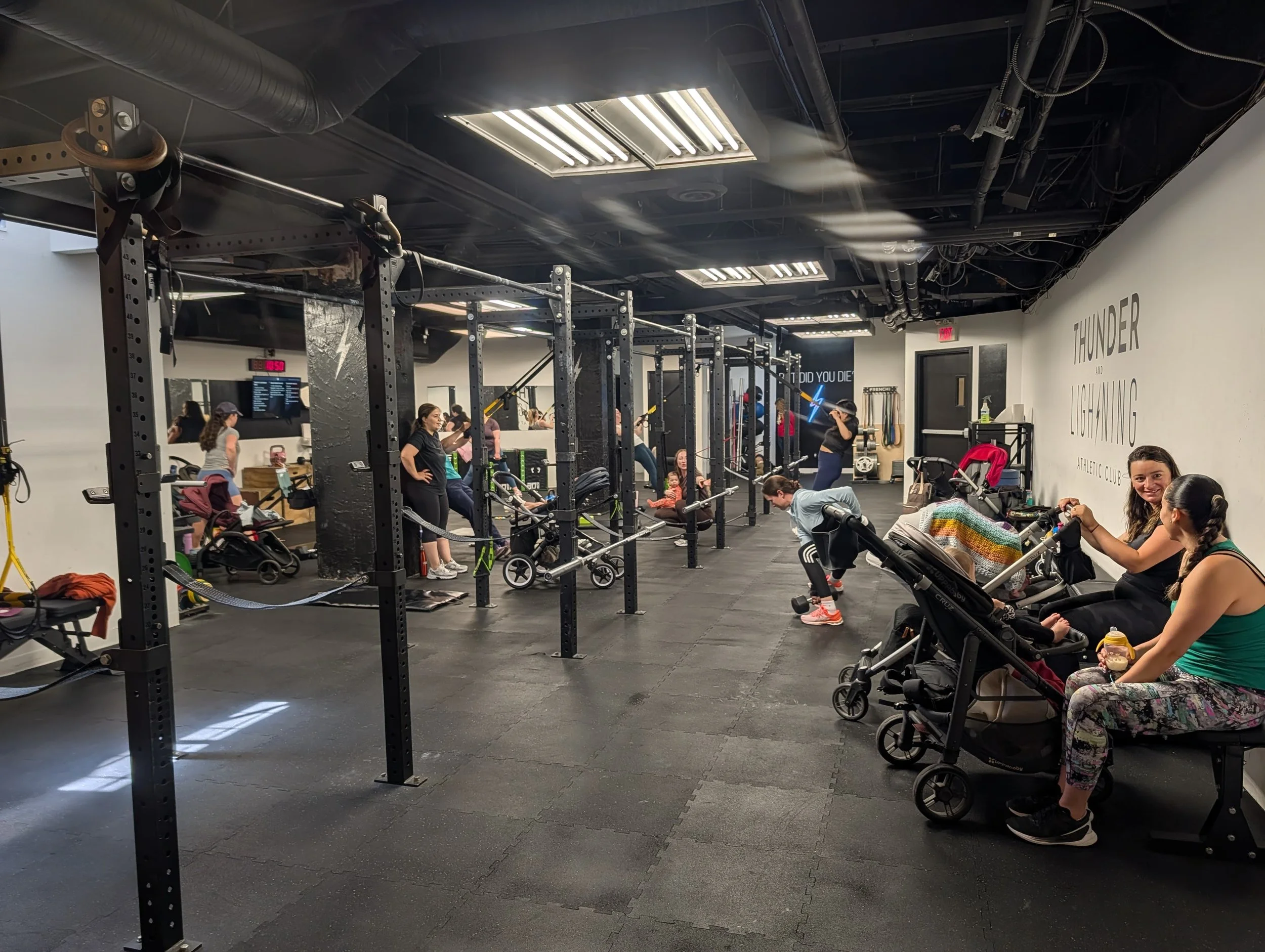
Getting back to training is not just about rebuilding physical strength, it is also about having an hour that belongs to you.
We have worked with a lot of new moms over the years. And the conversation that comes up more than almost any other is some version of the same thing.
They miss moving. They miss feeling strong. They miss having something that is theirs. And they are not sure what is safe anymore, or when they are allowed to start, or how to do any of it when they can’t leave their baby for long enough to get to a gym.
We built something specifically for that problem. But before we get to that, here is what we know about coming back to training after having a baby, because the how matters as much as the when.
When Can You Actually Start?
The honest answer is that it depends on the person. Some women are ready to start at six weeks. Others need three months or more before their body is ready to begin rebuilding. Recovery is not linear and it is not the same for everyone, and anyone who gives you a single number as a hard rule is oversimplifying.
What being cleared by your doctor actually means is that your body is ready to begin moving again with appropriate guidance. For most women that does not mean returning immediately to exactly what you were doing before pregnancy. But here is what it does mean: every exercise and every movement can be scaled to where you are right now and progressed as you get stronger. There is no minimum fitness level required to start. There is no benchmark you need to hit before you are allowed through the door. You start where you are and the program builds from there.
What your body needs first is not intensity. It is foundation. Rebuilding the connection between your brain and your core. Relearning how to brace properly. Strengthening the pelvic floor before you start loading it with heavier movement. This work is not exciting and it does not look impressive on paper. But it is the reason some women return to full strength training within a few months while others are still dealing with symptoms a year later.
The difference is almost always whether that foundation got built properly at the start.
What Your Body Has Actually Been Through
Pregnancy and birth are significant physical events. Your abdominal muscles stretch and separate to accommodate a growing baby. Your pelvic floor carries the weight of pregnancy and manages the demands of birth. Your hormones, your posture, your movement patterns, all of it shifts over nine months. That does not reverse itself the moment you are cleared to exercise.
Three things come up consistently with the postpartum moms we work with.
The first is diastasis recti. This is the separation of the rectus abdominis muscles along the midline and some degree of it is present in the majority of women after pregnancy. It does not mean you can’t train. It means certain exercises need to be modified or avoided until the tissue has recovered sufficiently. We have seen women push through this without guidance and set their recovery back significantly. We have also seen women address it properly from the start and be back to full loading within a few months. The difference is knowing what to look for and having a coach who does too.
The second is pelvic floor dysfunction. Leaking when you jump or cough. A feeling of heaviness or pressure. Discomfort during exercise. These symptoms are common in the postpartum period and they are not something you simply have to accept as the new normal. They are signals that the pelvic floor needs specific attention before being loaded. If you are experiencing these symptoms, working with a pelvic floor physiotherapist alongside a postpartum trained coach is the approach we recommend without hesitation.
The third is cesarean recovery. A C-section is major abdominal surgery and the recovery timeline and movement considerations are meaningfully different from a vaginal birth. The scar tissue, the healing of the abdominal wall, and the impact on core function all need to be factored into how training is approached. A coach who understands this will program accordingly rather than applying a one size fits all approach to a situation that is anything but.
What Coming Back Actually Looks Like
The return to training after having a baby is not about getting back to where you were as fast as possible. We know that is not what most women want to hear. But it is true, and the women who understand it from the beginning have significantly better outcomes than the ones who treat it as a race.
In the early weeks the work looks like breathing and bracing, gentle core reconnection, and movements that rebuild functional strength without placing excessive demand on a system that is still recovering. Bodyweight squats. Hip hinges. Rows. Carries. Movements that mirror what you are already doing every day as a new mom, because functional strength for motherhood is the actual goal, not just getting back to a number on the bar.
As your body recovers the loading increases. The movements become more demanding. The program evolves week by week. By three to six months postpartum, most women who have trained consistently with a good coach are lifting weights that would have seemed unrealistic when they started.
We have watched this happen enough times to say with confidence that the women who come back carefully and build the foundation properly get further, faster, than the ones who rush it. The body rewards the investment.
The Part That Does Not Get Talked About Enough
The physical side of postpartum recovery gets most of the attention. But there is something else happening in those early months that affects a lot of new moms more than they expect, and more than most will readily admit.
It is isolating. You are home with a baby who can’t hold a conversation and is exceptionally demanding. It’s a one way street. Your social world has contracted in ways you did not fully anticipate. Your identity has shifted. The things that used to give you a sense of yourself, your work, your training, your independence, are suddenly much less available. That is a real and significant adjustment.
Getting back to training is not just about rebuilding physical strength. It is about having an hour that belongs to you. Being around other adults who understand what you are going through. Feeling capable again in your body. We have seen what that does for women in the postpartum period and it goes well beyond fitness.
The moms who train consistently in this period consistently report not just better physical outcomes but better mental health outcomes. That is not a coincidence.
the women who come back carefully and build the foundation properly get further, faster, than the ones who rush it.
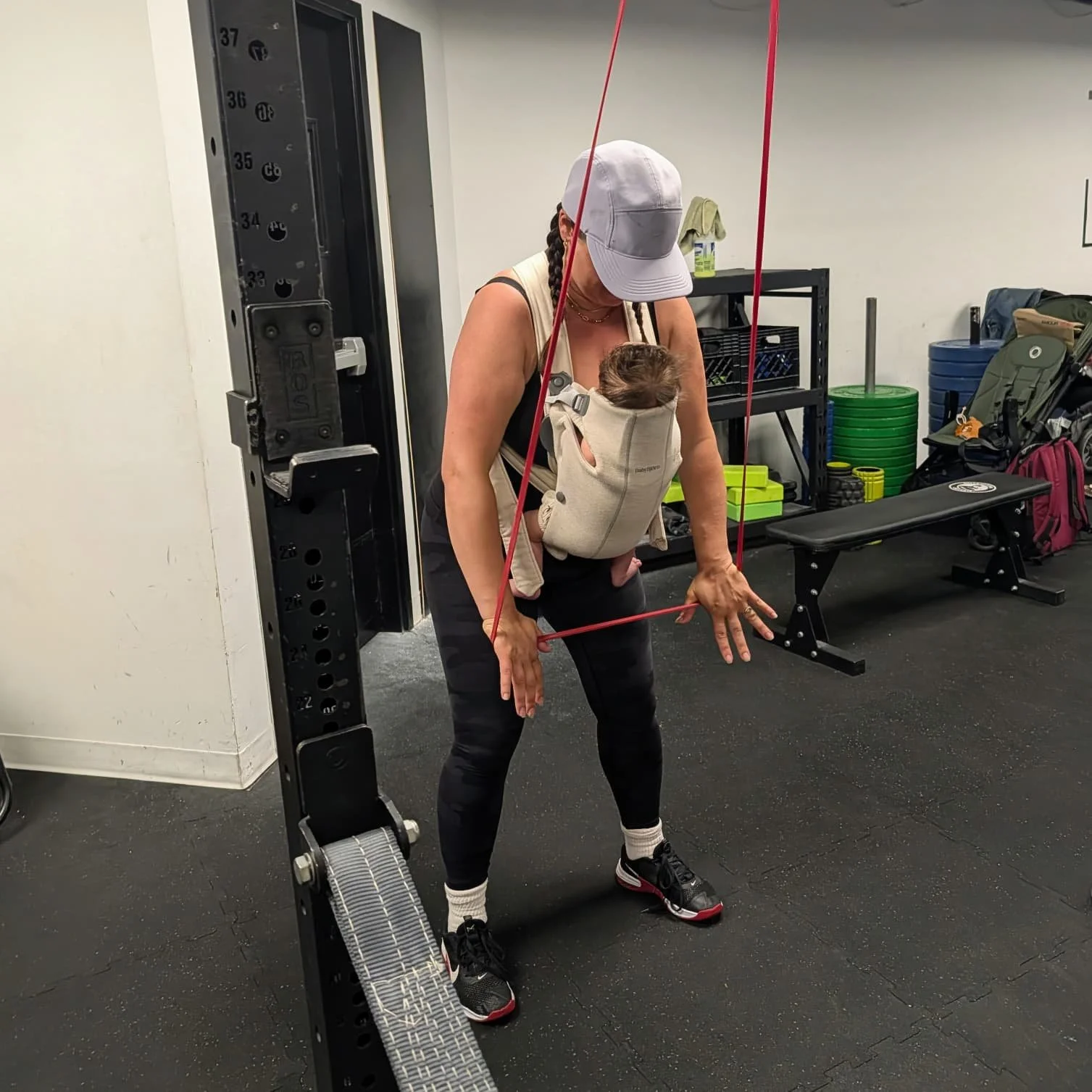
Strength training with your baby with you, and women who are on a similar path.
Why We Built the Mom and Baby Program
We kept seeing the same barrier come up over and over. Women who were ready to train, who wanted to train, who knew it would help them. And the thing stopping them was not motivation or time or money. It was that they could not figure out childcare.
So we removed that barrier entirely.
Bring the baby.
Our Mom and Baby classes run Tuesdays and Thursdays at 10am and 11am in downtown Vancouver. Your baby comes with you, no babysitter needed. They sleep in their stroller, they watch from a carrier, they play on a mat or chill in the playpen. When they cry you pause, feed them, change them, soothe them, whatever they need, and then you keep going. Everyone in the class is a mom. Nobody is rushed. Nobody minds. We have genuinely never had a session where a crying baby was a problem, because the whole room understands completely.
The program runs in eight week sessions at $350, which is sixteen coached sessions across the two months. The group is deliberately small, between eight and twelve moms, so the coaching is attentive and the environment actually feels like a community rather than a class.
Our coach is trained in postpartum recovery and knows diastasis recti, pelvic floor considerations, and cesarean healing. The programming is built around getting you back to barbell training safely and progressively, because that is what most of the women who come to us actually want. They were lifting before pregnancy and they want to lift again. Not just move their body generally, but get back under a bar, rebuild their strength, and feel like themselves again in the gym. If you are coming in with a lifting background, even a basic one, this program will meet you there and build on it. If you are newer to strength training but want to learn, that works too. The foundation we build in the early weeks is the same either way. What changes is where the program takes you from there.
What you get over those eight weeks is a foundation of strength built correctly from the beginning, a group of women who are at exactly the same stage of life as you, and two hours a week that are genuinely yours.
The women who come through this program almost universally describe the same two things. They are stronger than they expected. And they feel significantly less alone than they did before they started.
Both of those outcomes matter to us.
Is This Right for You?
If you are six or more weeks postpartum, cleared by your doctor, and ready to rebuild strength in a coached environment where your baby is welcome, yes. This is for you.
We will meet you where you are and build from there.
The next eight week session is starting soon.
Questions before you commit? Reach out directly and we will answer them honestly.