
How to Actually Build Muscle: What the Next 12 Weeks Could Do For You
Building muscle isn’t complicated, but it is specific.
We have been coaching people who want to build muscle for close to twenty years each. Some people struggle to gain muscle. Trust us, we’ve seen it.
They are training. They are showing up consistently. They are putting in real effort. And the results are not matching what the effort deserves. So they assume they need to train harder, or try a different program, or that their genetics are working against them.
Almost none of that is true. What is almost always true is that one or two variables are quietly falling short of what the body actually needs, and because nobody has ever told them exactly what those variables are or how to measure them, they keep training hard and wondering why nothing is changing.
Here is what we know: building muscle is not complicated. It is just specific. And most people are not being specific enough.
What Actually Builds Muscle
There are five variables that drive muscle growth. If all five are in place and you are consistent, you will build muscle. If one or two are consistently falling short, you will not, regardless of how hard you train.
Progressive overload Your muscles adapt to the demands you place on them. Once they adapt they stop growing in response to that stimulus. To keep growing you need to keep providing a new challenge. More weight, more volume, more difficulty, applied in a logical progression. A program that tracks your loads and builds on them deliberately does this. A collection of workouts that varies without a clear direction does not. Most people think they are progressively overloading. Most people are not doing it as consistently or as deliberately as they need to be.
Protein Muscle is built from protein. Without enough of it your body does not have the raw materials to build new tissue regardless of how hard you train. The target for muscle gain is around 1.6 to 2.2 grams of protein per kilogram or 0.73 to 1.0 grams of protein per pound of bodyweight per day. When we tell most people that number they look at us like we have said something unreasonable. Then we look at what they are actually eating and the gap between where they are and where they need to be is significant. This is the variable we see fall short most consistently and it is the one that makes the biggest difference when it gets fixed.
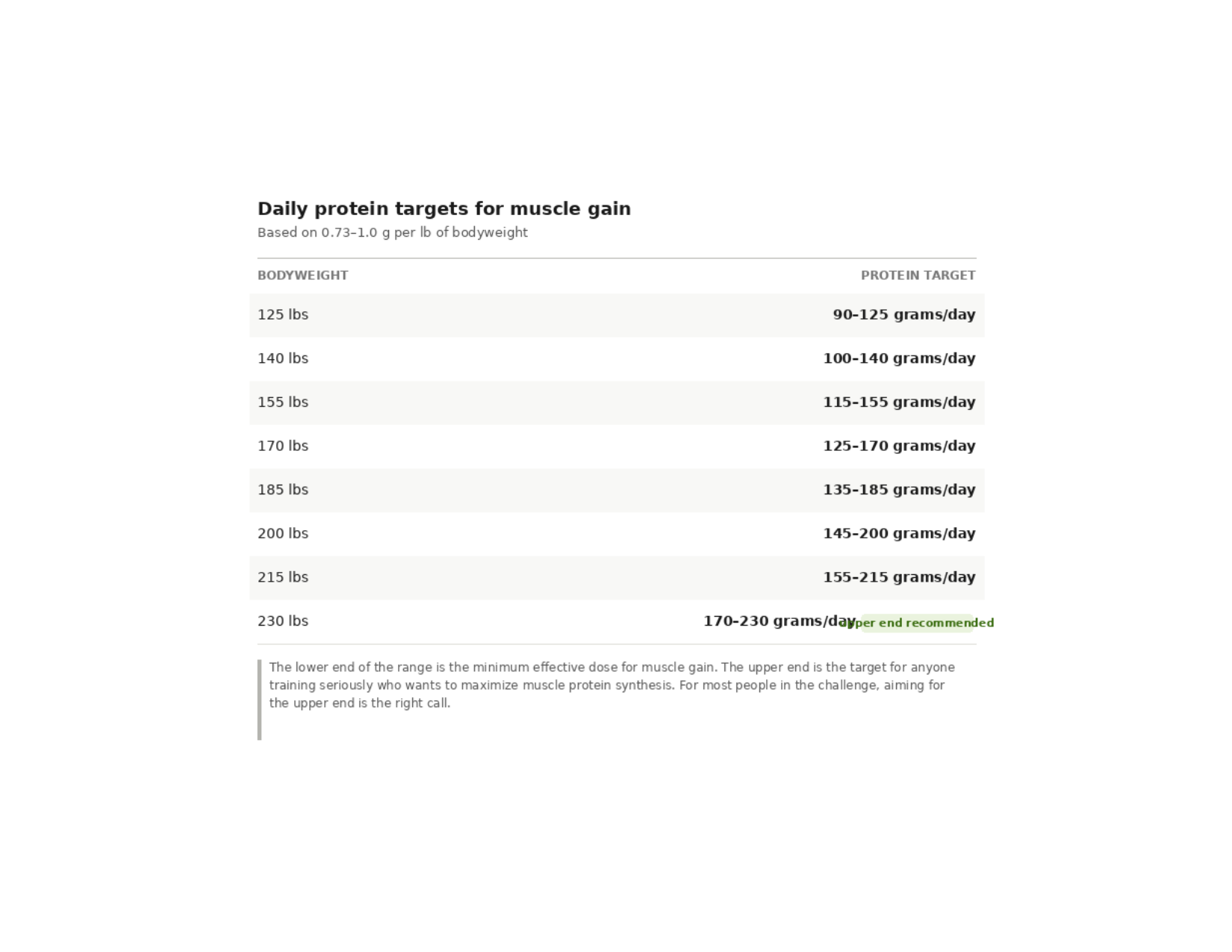
Quick guide for protein estimates.
Calories You cannot build significant muscle in a meaningful caloric deficit. Building new tissue requires energy. That does not mean eating everything in sight. It means eating enough to support the work you are doing and the growth you are asking your body to produce. A modest surplus of around 200 to 300 calories above your maintenance needs is usually the right range for lean muscle gain without excessive fat accumulation. Most people trying to build muscle are either eating too little because they are also trying to lose fat, or eating too much and gaining more fat than muscle. Getting this number right matters.
Sleep This is the variable most people underestimate and the one we find ourselves talking about most. You do not build muscle in the gym. You build muscle recovering from the gym. The training session is the stimulus. Sleep is where the adaptation happens. Seven to nine hours of quality sleep per night is not a lifestyle preference. It is a functional requirement. Chronically short sleep elevates cortisol, suppresses the anabolic hormones that drive muscle growth, and significantly blunts the results of training that is otherwise well structured. We have seen people turn their results around almost entirely by fixing their sleep. It is that significant.
Consistency over time Muscle gain is slow. A realistic rate for most people under good conditions is between 0.5 and 1 kilogram of lean mass per month. Over 12 weeks that is a meaningful and visible change. Over a year it is transformative. The people who build impressive amounts of muscle are not the ones who trained the hardest for a month. They are the ones who got the variables right and stayed consistent long enough for the results to compound.
Why Most People Plateau
If you have been training for a while and feel like your muscle gain has stalled, we can tell you with reasonable confidence what is causing it without even seeing your program.
Protein intake that looked adequate but was not consistently hitting the target. A training program that stopped progressing because the loads were not being pushed deliberately enough. Sleep that was functional but not optimal. Or not enough calories sustained consistently over time.
Muscle gain plateaus are rarely mysterious. They are almost always one or two variables quietly falling short, compounding over weeks until progress stops. The frustrating thing is that most people respond to a plateau by changing their training when the answer is usually somewhere in their nutrition or their recovery.
This is exactly why measurement matters. Feeling like you have built muscle and actually having built measurable lean mass are two different things. The basic scale does not tell you which is happening. It cannot distinguish between muscle, fat, and water. A body composition scan can.
Why We Use the Evolt 360
At Thunder & Lightning we use the Evolt 360 body composition scanner because it takes the guesswork out of this entirely.
The Evolt 360 measures your lean muscle mass, body fat percentage, visceral fat rating, and a detailed breakdown of your body composition in under a minute. It gives you a precise starting point and, when repeated after a period of structured training and nutrition, an objective measure of exactly what changed and what did not.
This matters more during a muscle building phase than at any other time. If you are gaining muscle and losing fat simultaneously, which is entirely possible particularly for newer or returning trainees, the scale might barely move while your body composition is changing significantly. Without a body composition scan you would have no way of knowing whether the work is paying off.
We are not interested in coaching people through twelve weeks of hard work and then giving them a vague sense that they look a bit better. We want to show them exactly what changed, in numbers, so that they know what works for their body and can keep building on it.
The 12 Week Muscle Gain Challenge
On June 15th we are running a 12 week structured muscle gain challenge open to both members and non-members. The entry fee is $99.
Here is what that gets you.
An Evolt scan and full analysis at the start and end of the challenge so you know exactly where you began and exactly what changed. A personalized nutrition plan built around your specific stats, including calorie targets, protein targets, and meal examples that actually fit your numbers. A customized action plan covering training, lifestyle, and recovery. Weekly accountability check-ins where you submit your training consistency, sleep, and nutrition adherence. Weekly educational content on protein, meal planning, hypertrophy training, recovery, and progressive overload. Access to a private WhatsApp group. And a final results session where progress is reviewed and winners are announced.
The winner is determined by percentage increase in lean body mass. That is the fairest metric available. It levels the playing field across different body sizes and starting points and measures exactly what the challenge is designed to produce.
The deadline to sign up is June 14th, the day before the challenge begins.
If you have been training consistently and the results have not matched the effort, this is the structure that closes that gap. Twelve weeks of knowing exactly what you need, tracking whether you are getting it, and having people around you doing the same thing.
We have seen what happens when people get all five variables right at the same time. It is not subtle.
[Sign up for the 12 Week Muscle Gain Challenge here.]
Take the Next Step
Questions about the challenge or want to talk through whether it is the right fit for where you are right now? Come in for a free No-Sweat Intro and we will walk you through exactly what the twelve weeks would look like for you.